Preprint · arXiv:2611.23616
Isthmus
Bridging Supervision Islands Restores Uncertainty and Stability in One-Step Flows
The idea, in motion
TL;DR
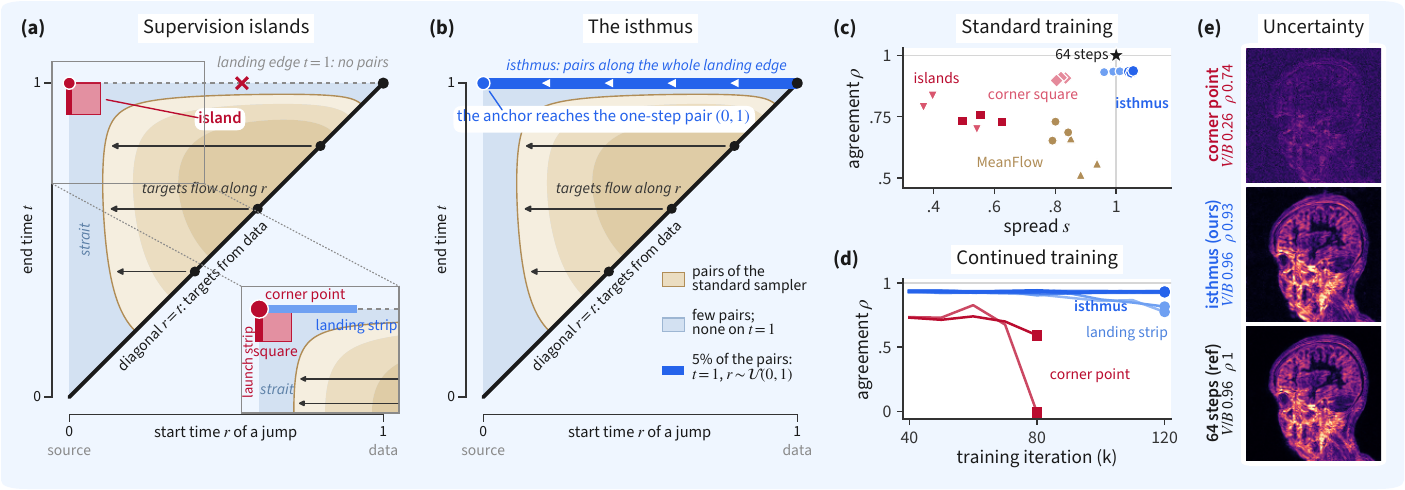
One-step flow maps are increasingly used as posterior samplers, where the point of sampling is the uncertainty that the samples carry. We find that the one-step jump of a standard flow-map model loses this uncertainty and becomes less stable than the same network sampled in many steps. Both failures come from where training places its pairs of start and end times: the one-step pair sits on a supervision island, cut off from the data-anchored diagonal. An isthmus spends 5% of the training pairs along the landing edge that joins this pair to the diagonal. The network, the loss, and inference are unchanged, and there is no added cost. On brain MRI, the isthmus restores one-step calibration to 0.96 and the correlation with 64-step samples to 0.93.
Key idea
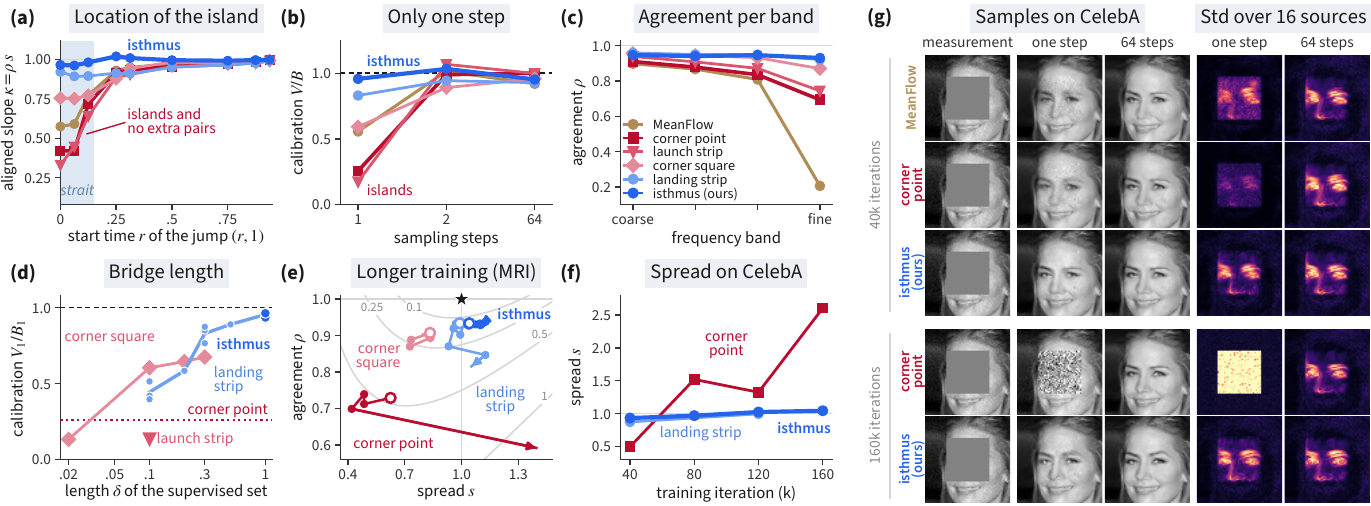
A flow-map network can jump from the source to the data in one step, or it can integrate the same flow in many short steps. If the one-step map is faithful, the two samplers should agree, both in their samples and in their spread. In the paper they do not: on brain MRI, the 64-step sampler of a standard MeanFlow model is close to calibrated, while the one-step samples of the same network are already under-dispersed (calibration \(0.67\), where \(1\) is exact) and only partly correlated with the 64-step samples (\(\rho = 0.58\)). Supervising the one-step jump directly makes this worse and collapses the samples toward the conditional mean (calibration \(0.26\)). When training is extended, the collapsed one-step sampler can break down, while the 64-step sampler of the same network stays intact.
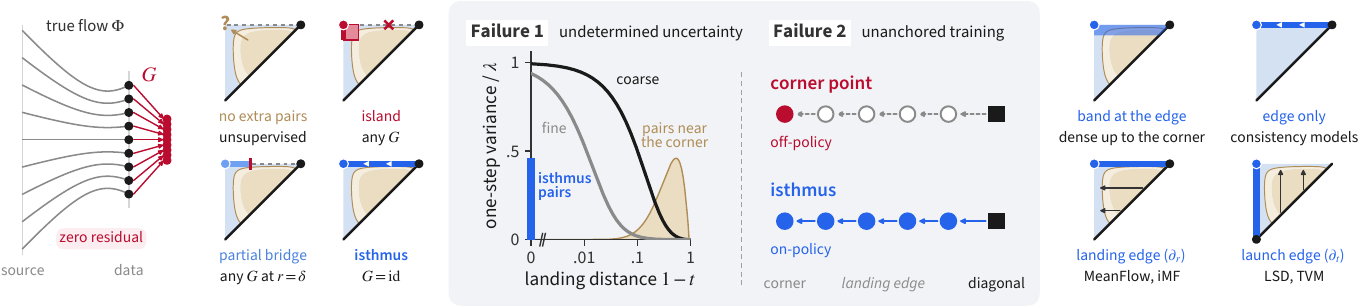
Both symptoms come from the geometry of training pairs. Training draws a start time \(r\) and an end time \(t\) from the triangle \(0 \le r \le t \le 1\). Only the diagonal \(r = t\) receives targets from the data, and the mean-flow identity passes this information along rows of constant end time. One-step sampling is the corner \((r, t) = (0, 1)\), which sits at one end of the landing edge \(t = 1\). The standard time sampler places no training pairs on this edge, so the corner is unsupervised. A pair placed at the corner alone is a supervision island: the identity does not connect it to the diagonal, the one-step map is not uniquely determined (an arbitrary map composed with the true flow still has zero residual), and its training targets rest on untrained pairs.
The remedy is a thin bridge. The error of the one-step map is bounded by the residual of the identity along the landing edge, so training controls this error once its pairs cover the whole edge. An isthmus is the simplest such sampler: with probability \(5\%\), a training pair is replaced by \(r \sim \mathcal{U}(0,1)\), \(t = 1\). Only the time sampler changes.
Theoretical Insights
Time pairs live in the triangle \(0\le r\le t\le 1\). Write \(X_u(z,r,t)=z+(t-r)\,u(z,r,t)\) for the jump of a velocity field \(u\), \(\Phi_{r\to t}\) for the true flow, and \(R\) for the residual of the mean-flow identity. A row is a line of constant end time \(t\); the row \(t=1\) is the landing edge \(\mathcal{E}_{\mathrm{land}}\). The bridge of a pair \((r_0,t)\) is the part of its row between the pair and the diagonal. The pair is bridged when \(C_\pi(r_0,t)=\int_{r_0}^{t} dr/\pi_t(r)\) is finite, where \(\pi_t\) is the training density along that row; otherwise, pairs added on a set containing it, without bridging it, form a supervision island. The statements below follow the paper; numbering matches the main text.
Theorem 1 (Off the diagonal the jump is free)
Fix an end time \(t\) and start times \([a,b]\) with \(b<t\). A \(C^1\) field \(u\) has zero residual on \([a,b]\times\{t\}\) if and only if
\[ X_u(\cdot,r,t)=G\circ\Phi_{r\to t}\qquad\text{for all } r\in[a,b] \]with a map \(G\) independent of \(r\), and every \(C^1\) map \(G\) is attained. If instead \(b=t\) and \(u\) is bounded, then \(G=\mathrm{id}\).
Intuition. A row that never reaches the diagonal can have zero residual and still leave an arbitrary map \(G\)—including collapse of every sample to the mean. Only a connection to the diagonal forces \(G\) to be the identity.
Theorem 2 (Bridge criterion)
Let \(r_0<t\), and let \(u(\cdot,\cdot,t)\) be \(C^1\) and bounded for \(r\in[r_0,t)\). For every \(z\), with \(z_r=\Phi_{r_0\to r}(z)\),
\[ X_u(z,r_0,t)-\Phi_{r_0\to t}(z)=\int_{r_0}^{t} R(z_r,r,t)\,dr. \]Hence \(e^2(r_0,t)=\mathbb{E}_{p_{r_0}}\|X_u(\cdot,r_0,t)-\Phi_{r_0\to t}\|^2\), the mean-square error of the jump, bounds the squared \(W_2\) distance between \(X_u(\cdot,r_0,t)_{\#}p_{r_0}\) and \(p_t\) and satisfies
\[ e^2(r_0,t)\le C_\pi(r_0,t)\int_{r_0}^{t}\pi_t(r)\,\mathbb{E}_{p_r}\|R(\cdot,r,t)\|^2\,dr. \]Intuition. The error of a jump is the residual accumulated along its bridge. Training controls this error once the sampler covers the whole edge from the pair to the diagonal; if a gap remains, the constant \(C_\pi\) is infinite and the bound is void.
Corollary 1 (The one-step corner)
The bridge of the corner is the landing edge.
- Training pairs on the whole edge with \(\pi_1\ge c>0\) give \(C_\pi(0,1)\le 1/c\), so the bridge bound controls the one-step error by the residual on the edge.
- Pairs only on \([0,\delta]\), \(\delta<1\), form a partial bridge: \(C_\pi(0,1)=\infty\), and the jumps share an arbitrary \(G\) at zero residual; \(\delta=0\) is the corner alone.
- Without pairs on the edge, \(C_\pi(0,1)=\infty\) and the population objective does not depend on \(u\) on \(\mathcal{E}_{\mathrm{land}}\). Other rows constrain the corner only through the continuity of the network in \(t\).
Intuition. An isthmus that covers the whole landing edge is exactly the condition that makes the one-step error controllable. Supervising the corner alone, or only a partial strip, leaves the one-step map free.
Method
In its default form the isthmus is a one-line change to any base time sampler with \(r \le t\). With probability \(\pi_{\mathrm{isth}} = 5\%\), the pair is replaced by a jump that starts at a uniform time and lands on the data. The new pairs are trained with the unchanged mean-flow target. Pairs are replaced rather than added, so the cost per iteration is unchanged. The analysis requires only \(\pi_{\mathrm{isth}} > 0\); shares from 2.5% to 10% perform alike in the paper’s ablations.
r, t = base_sampler(n)        # any sampler, r <= t
isth = rand(n) < 0.05         # 5% of the examples
r = where(isth, rand(n), r)   # start ~ U(0, 1)
t = where(isth, 1.0, t)       # end on the data
Because the base sampler has no pair on the landing edge, the one-step error is bounded by the mean-square residual over the isthmus pairs. A small error implies closeness to the data distribution in Wasserstein-2 distance and agreement with the multi-step samples. Calibration further requires an error that is small relative to the posterior variance, which the bound does not itself provide; it is tested empirically.
Main results
The experiments change only the time sampler. The main setting is posterior sampling for \(8\times\) accelerated MRI on IXI brain slices, with a conditional U-Net trained with the MeanFlow loss for 40k iterations, reported as means over three training seeds. The same comparisons are repeated on fastMRI knee data and CelebA inpainting, and with the official MeanFlow code on unconditional CIFAR-10 and ImageNet \(32\times 32\).
With 64 steps, every network in the comparison is close to calibrated (\(V/B = 0.92\)–\(1.03\)), so the network itself has learned the uncertainty of the posterior. Without an isthmus, the same networks in one step reach only \(V/B = 0.56\)–\(0.84\). With the isthmus, every recipe reaches paired correlation \(\rho \ge 0.93\), and MeanFlow and SNaP become the only one-step samplers that are both consistent with 64 steps and calibrated (\(V/B = 0.96\) and \(0.95\)).
| Training pairs | \(V/B \to 1\) | \(\rho \to 1\) |
|---|---|---|
| MeanFlow, no extra pairs | 0.67 | 0.58 |
| Corner point (island) | 0.26 | 0.74 |
| Launch strip | 0.17 | 0.77 |
| Landing strip | 0.83 | 0.93 |
| Isthmus (ours) | 0.96 | 0.93 |
| 64-step reference | 0.96 | 1 |
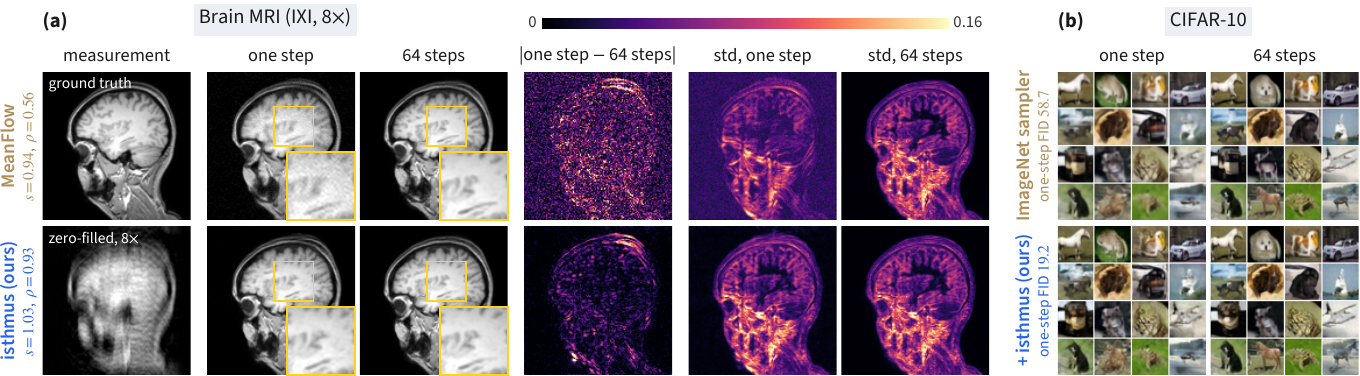
Moving the same 5% of pairs between regions of the triangle isolates the effect of placement. The isthmus is the only region whose one-step samples are both consistent with 64 steps and calibrated, with \(V_1/B_1 = 0.96\) on IXI — the same calibration as 64 steps — and it is also the best region on the knee (\(V_1/B_1 = 0.83\), \(\kappa_{\mathrm{f}} = 0.67\)). Islands fail in the other direction: they can raise correlation but shrink the spread (\(V_1/B_1 = 0.26\) at the corner point, \(0.17\) on the launch strip). The landing strip, which covers only the first 0.3 of the landing edge, comes in second. On CelebA inpainting, the isthmus keeps the one-step spread close to 64 steps (\(V_1/V_{64} = 0.91\)), while the corner point collapses it to 0.37 and later breaks down under longer training.
| Method | CIFAR-10 FID1 \(\downarrow\) | ImageNet 32 FID1 \(\downarrow\) |
|---|---|---|
| MeanFlow | 58.7 | 46.2 ± 12.6 |
| + isthmus (ours) | 19.2 | 34.8 ± 1.5 |
BibTeX
@article{yang2026isthmus,
  title={Isthmus: Bridging Supervision Islands Restores Uncertainty and Stability in One-Step Flows},
  author={Yang, Luming and Li, Siqing and Liu, Haoxian and Bu, Zhenyu and Zhu, Jiazheng and Yilmaz, Alper},
  journal={arXiv preprint arXiv:2611.23616},
  year={2026}
}